In this week’s guest article written by Crossroads movement specialist Christina Corsetty, discover how individualized exercise programming and health and wellness coaching came together to support his progress—and why small, consistent steps deserve recognition.
Christina combines functional movement assessment, individualized exercise programming and health and wellness coaching to help patients at Crossroads build strength, mobility, balance and confidence in everyday movement. As a National Board Certified Health & Wellness Coach and Functional Movement Specialist, she helps patients develop practical routines that fit their goals, abilities and lives.
-------------------------------------
The body’s ability to adapt to exercise continues later in life. Research involving adults in their seventies through nineties has demonstrated improvements in muscle strength and physical function with supervised resistance training. Age alone did not eliminate the opportunity to become stronger. [1]
Putting that potential into practice requires an appropriate starting point, a manageable routine, and opportunities to progress. Functional movement assessment, individualized exercise programming and health and wellness coaching each contribute to that process.
One patient’s experience in the Functional Movement Restoration Program illustrates how these pieces can come together. Across two programs, follow-up measurements documented substantial improvements in physical performance, mobility, and several aspects of standing balance.
A Program That Fits Your Life
The Functional Movement Restoration Program at Crossroads is designed as an at-home exercise program, with individualized exercises to complete between appointments. It can also be adapted for a combination of home and gym exercise or an entirely gym-based routine, depending on the patient’s preferences, available equipment and movement needs.
For this patient, going to the gym was important. Gym equipment and workouts were incorporated into the plan, complementing existing upper-body exercise while addressing additional needs in lower-body strength, foot and ankle mobility, balance and controlled movement.
Follow-up visits provided opportunities to review the patient’s response and determine what to maintain, modify or progress. The location of exercise could be flexible while the program remained focused on the patient’s goals.
Patient Progress Over Eight Weeks
Across two movement programs over eight weeks, consistent participation was accompanied by measurable progress:
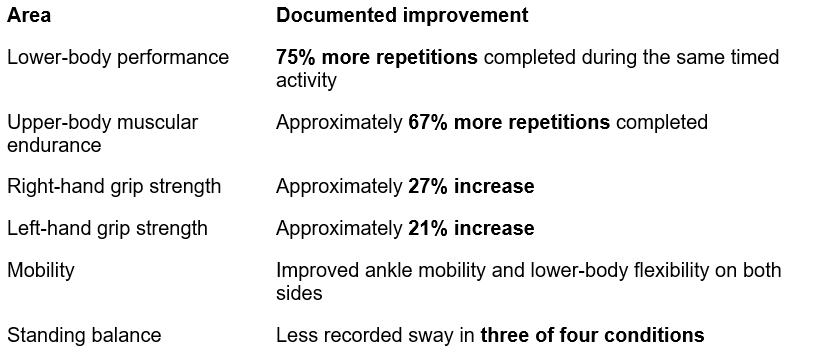
The repetition gains reflect improved performance and endurance, rather than an equivalent percentage increase in maximum muscle strength. Grip measurements separately demonstrate increased hand strength.
What does that mean in everyday language? He completed about seven lower-body repetitions for every four he could complete at the start, and about five upper-body repetitions for every three initially. Both were completed within the same testing time. His right-hand grip strength increased by more than one-quarter, and his left by about one-fifth.
These are meaningful accomplishments to recognize: he could do more in the same amount of time, grip more strongly with both hands and maintain steadier standing balance in three testing conditions. These abilities matter for everyday tasks such as getting out of a chair and holding or carrying objects, although those daily activities were not directly measured.
I am proud of the consistency he brought to this process, including his willingness to adjust when an injury changed what he could do. His progress gives us concrete achievements to celebrate and a foundation to keep building on.
Not every result improved. One balance condition showed increased sway, and upper-body mobility remained an area requiring attention. Those findings helped identify priorities for the next program.
How Balance Was Measured
Standing balance was assessed using the Biodex, an instrumented platform that records how much a person sways while standing.
The assessment includes eyes-open and eyes-closed conditions on firm and foam surfaces. Changing these conditions helps show when maintaining stability becomes more challenging. Results provide one way to monitor standing balance alongside other movement assessments. [2]
For this patient, recorded sway decreased in three conditions. That describes improved performance during those tasks; it does not establish that every aspect of balance improved or that the risk of falling decreased.
Consistency Continued Through an Injury
The patient continued participating while managing an injury. Exercise choices were adjusted to accommodate limitations while allowing appropriate activity to continue.
Consistency did not mean performing the same exercises regardless of symptoms. It meant finding a workable way to remain engaged while respecting what needed to change.
With guidance from the treating clinician, continuing may mean doing less, choosing different movements or temporarily focusing on another goal.
This patient’s experience highlights the value of a plan that can adapt, rather than treating exercise as an all-or-nothing commitment.
How the Body Responds to Training
Some strength improvements can develop before visible changes in muscle size. Early adaptations can involve how the nervous system activates muscles to produce force.
In one study, researchers documented increased force alongside changes in motor-unit recruitment and firing rates after four weeks of strength training. This demonstrates one way the body can respond early in training, although results depend on the individual and the exercise involved. [3]
The patient’s measurements demonstrate improved performance. They do not establish precisely which adaptations occurred or how much muscle was gained.
Bringing Movement and Behavior Change Together
My approach combines functional movement assessment, individualized exercise programming and health and wellness coaching.
Assessment helps identify priorities. Programming provides an appropriate movement plan. My background as a National Board Certified Health & Wellness Coach adds support for putting that plan into practice.
That work can include exploring meaningful goals, discussing barriers, identifying manageable next steps and helping patients recognize their progress. The aim is to support self-efficacy or the belief that a person can take action and influence their health.
In a randomized trial involving older adults, adding interpersonal strategies, such as shared problem-solving and learning from others, to exercise and activity monitoring produced greater increases in physical activity through 12 months. Goal-setting strategies alone did not provide the same additional benefit. [4]
Although this trial did not test this program, it supports addressing participation alongside exercise instruction.
Building on Progress
The patient is now moving into a third program, with a focus on continuing to develop strength and function while addressing remaining challenges.
His progress occurred alongside consistent participation in the movement program and gym exercise; this case cannot separate their individual contributions.
Regular physical activity can also support sleep, emotional well-being, bone health and independence. These broader benefits are supported by evidence summarized by the Centers for Disease Control and Prevention; they were not measured as outcomes in this patient’s case. [5]
Small steps do not have to be perfect steps. An appropriate plan, consistent participation and room to adjust can help create opportunities for meaningful progress.
This case describes one patient’s observed progress. Individual results vary.
More about the Functional Movement at Crossroads
What it is:
Billed through insurance for patients of Integrative Medicine at Crossroads for patients with prior medical clearance.
Our Functional Movement Assessment evaluates how your body moves as a coordinated system. As we age or become less active, strength, posture, balance, and coordination often decline. In under an hour, our movement specialist guides you through a series of structured movements such as sit to stand, reaching, lifting, core stabilization, and balance tasks to identify inefficiencies, compensation patterns, and areas of weakness.
Who is it for:
This service is ideal for older adults, individuals new to exercise, those managing chronic conditions, people returning after inactivity, and anyone who wants to move more safely and confidently. The goal is not simply to exercise more, but to move better.
What to do with the results:
In a follow-up session after the initial assessment, our movement specialist Christina Corsetty, MA, NBC-HWC, SFS will review your results and develop a targeted corrective exercise plan designed to reduce strain, improve stability, and lower injury risk.
How to book:
Text Klara: patient.klara.com
References
Fiatarone, M. A., O’Neill, E. F., Ryan, N. D., Clements, K. M., Solares, G. R., Nelson, M. E., Roberts, S. B., Kehayias, J. J., Lipsitz, L. A., & Evans, W. J. (1994). Exercise training and nutritional supplementation for physical frailty in very elderly people. The New England Journal of Medicine, 330(25), 1769–1775.
https://pubmed.ncbi.nlm.nih.gov/8190152/
Dawson, N., Dzurino, D., Karleskint, M., & Tucker, J. (2018). Examining the reliability, correlation, and validity of commonly used assessment tools to measure balance. Health Science Reports, 1(12), e98.
https://pubmed.ncbi.nlm.nih.gov/30623052/
Del Vecchio, A., Casolo, A., Negro, F., Scorcelletti, M., Bazzucchi, I., Enoka, R., Felici, F., & Farina, D. (2019). The increase in muscle force after 4 weeks of strength training is mediated by adaptations in motor unit recruitment and rate coding. The Journal of Physiology, 597(7), 1873–1887.
https://pubmed.ncbi.nlm.nih.gov/30727028/
McMahon, S. K., Lewis, B. A., Guan, W., Wang, Q., Hayes, S. M., Wyman, J. F., & Rothman, A. J. (2024). Effect of intrapersonal and interpersonal behavior change strategies on physical activity among older adults: A randomized clinical trial. JAMA Network Open, 7(2), e240298.
https://pubmed.ncbi.nlm.nih.gov/38421648/
Centers for Disease Control and Prevention. (2025, December 4). Physical activity benefits for adults 65 or older.
https://www.cdc.gov/physical-activity-basics/health-benefits/older-adults.html